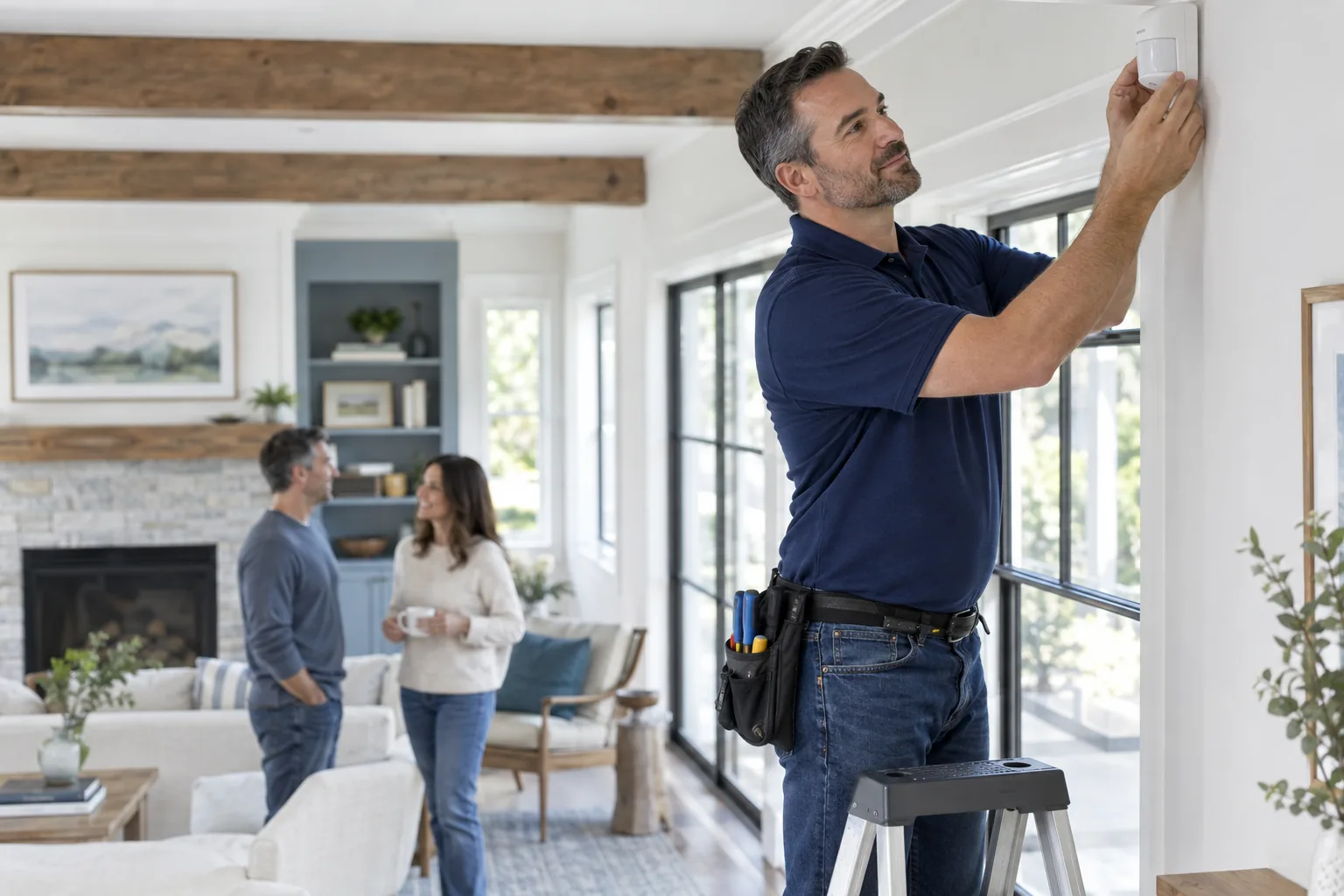
Most people start by searching for a price. That's fair, but it's the wrong first question, because two homes on the same street can need very different systems. A one-story house with two doors and a fenced yard isn't the same job as a two-story house with a walkout basement, a side gate and a detached shop. The number follows the home, not the other way around.
So instead of a price list, here's what actually moves the number, and how to keep it where you want it.
Start with what you're protecting against
Write down the one or two things that would actually bother you. Packages walking off the porch. Someone trying the back door at night. A parent living alone who might fall. A shop full of tools. A house that sits empty when you travel.
Each of those points to different equipment. Package theft is a doorbell camera that can see a face, not just the porch light. A back door worry is a door sensor, a motion sensor and a camera that covers the approach. An empty house is monitoring, so someone responds when you can't. When you know the goal, you stop paying for things that don't serve it.
What changes the number
How many ways in. Every exterior door, ground-floor window, garage service door and basement window is a possible entry point. More entry points means more sensors. We use wireless door and window sensors wherever a home needs them, so there's no drilling through trim or running wire through finished walls.
Layout and size. A long ranch house or a two-story house may need more than one motion sensor and a keypad near a second entry. Homes on acreage often add coverage for barns, shops and gates.
Cameras. The count matters less than where they go. Three cameras in the right spots beat eight that watch the sky. Recording and storage choices matter too. We walk you through those options before you decide, so there are no surprise monthly fees. If you want to plan placement first, start with our blind spot guide.
Monitoring. A system can alert only your phone, or it can alert a 24/7 monitoring center that can send police, fire or EMS. Monitoring is the part that gets help to the house when you can't. It's usually a monthly service, and some packages come with a monitoring agreement. If yours does, we go over the terms before you sign anything. See how 24/7 monitoring works.
What's already on the wall. If the house has an alarm panel, sensors or cameras, some of it may be worth keeping. Reusing good equipment is one of the easiest ways to lower the number. Here's how a takeover works.
Extras that make life easier. Smart locks, smoke and CO detection, and smart home controls can all tie into the same app. They're easy to add later, so they don't all have to happen on day one.
The Oklahoma City permit
If your home is inside Oklahoma City limits, the city requires an alarm permit within 15 days of the system starting to work, and it renews every year. The fee is small, but it matters for a bigger reason. The city says police don't investigate automatic burglar alarms from systems without a permit. Panic, hold-up and fire alarms are always investigated. (City of Oklahoma City)
The city also allows three false alarms in a 365-day period. After that, each police or fire response to a false alarm carries a fee, and six can get the permit revoked. That's a real cost of a poorly set-up system, and it's one more reason placement and pet-aware motion settings matter.
Other cities have their own rules. Choctaw and El Reno have permit and false alarm ordinances, and Nichols Hills requires free registration. We'll go over what your city asks for. See your area on our service areas page.
Ways to keep the number where you want it
- Cover the doors that matter first. Most homes have one or two entries that get used and a couple nobody sees from the street. Those are where to start.
- Reuse what works. A working panel or good cameras from the last owner can stay.
- Start simple and add on. A good system lets you add cameras, locks or detectors later without starting over.
- Don't buy coverage you'll never look at. If nobody will ever watch a camera's view, it probably shouldn't be on the list.
- Get the false alarm settings right. It's cheaper to set motion sensors around your pets on install day than to pay fees later.
What the free assessment covers
Every quote starts with a free on-site assessment. It takes about two hours. We walk the inside and outside of your home with you, the way someone casing it would, and point out the blind spots: dark entries, side gates, windows nobody can see from the street. We also check Wi-Fi strength and power at each camera spot, and we look at any equipment that's already there.
You leave with a clear quote and a plan that shows what would go where and why. Nothing gets installed until you decide. If you go ahead, most installs are a four-hour visit, and we walk you through the panel and app before we leave.
Total Protection Connection is a veteran-owned, local company in Oklahoma City. We're licensed to install ADT, but we design systems with or without ADT equipment, so the plan fits your home instead of a boxed package.
FAQs
Why don't you list prices online?
Because the honest answer depends on your home. A price list would either be too low for most homes or too high for simple ones. We'd rather walk the house and give you a real number.
Is the assessment really free?
Yes. It's free, it takes about two hours, and there's no obligation to buy.
Can I start small and add more later?
Yes. Many customers start with the main doors and a couple of cameras, then add locks, detectors or more cameras later.